Blinds, Shades & Curtain Rods: Level, Plumb & Aligned the First Time
By Brandon Mayernik · June 12, 2026
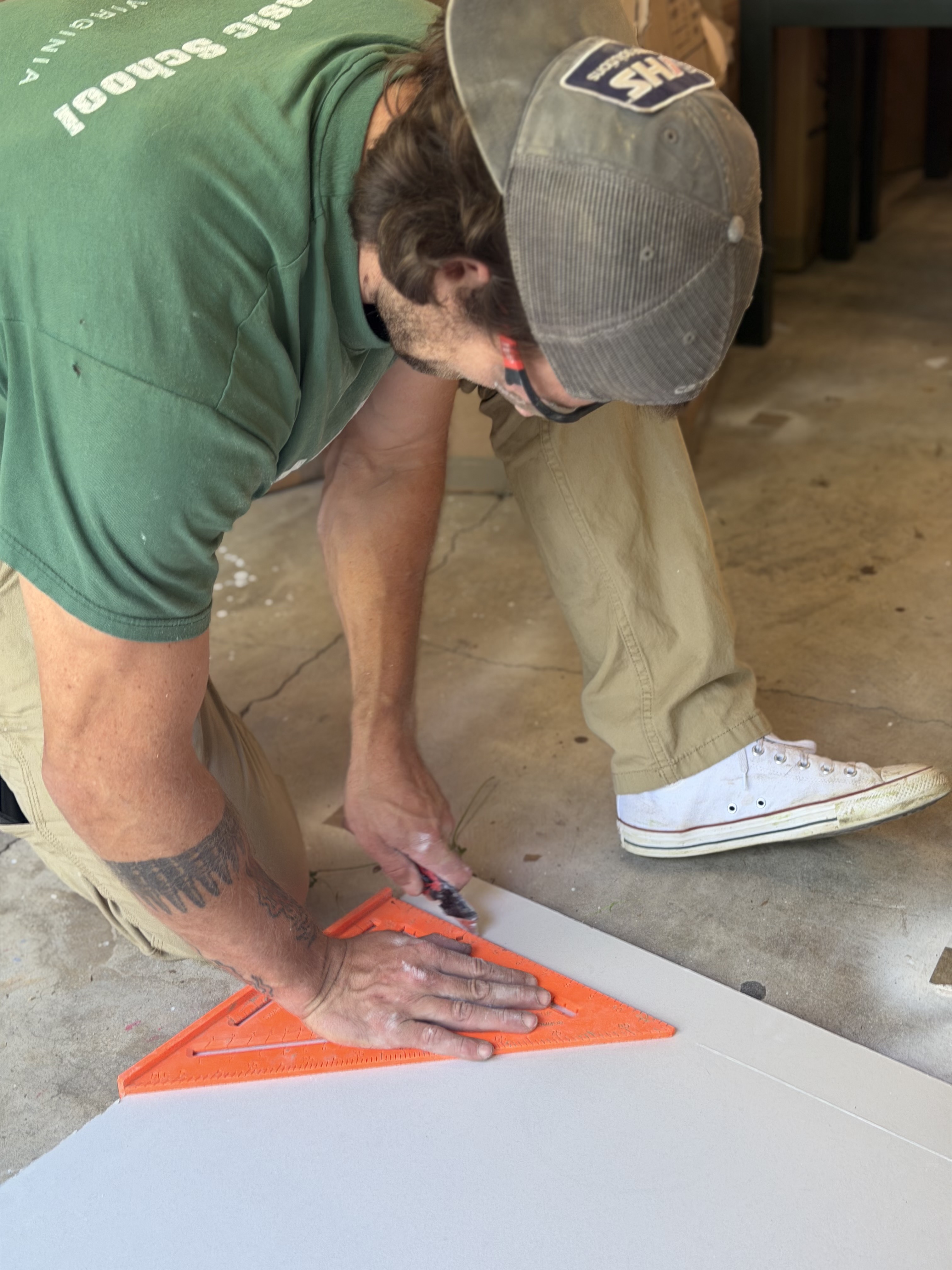
A lot of blinds calls start the same way: "we hung them ourselves and they're crooked, can you come fix them?"
I don't say this to make anyone feel bad — hanging window treatments looks easy and is genuinely harder than it looks. The brackets are tiny, the screws are tiny, the windows are rarely perfectly square, and the eye picks up a quarter-inch of tilt across a six-foot window from across the room. One off-level blind in a living room is the thing your guests notice.
Window treatments are classic half-day handyman work — a single living room with new blinds and a curtain rod is maybe two hours on site. A whole-house batch (8–12 windows) is a full-day project that ends with every window in the house looking like the catalog photo. Here's how I think about getting them right the first time.
Measuring: Inside-Mount vs Outside-Mount
Before you buy a single blind, decide whether it's going inside the window frame or outside of it. This decision changes the measurements, the brackets, and the finished look.
- Inside-mount. The blind sits inside the window casing, flush with the wall. Clean, modern, shows off the trim. Requires at least 2" of depth inside the frame (more for some cellular shades), and a frame that's reasonably square. Measure the narrowest width and the shortest height — don't average.
- Outside-mount. The blind sits on the wall above the window, covering the frame entirely. Better for windows with shallow depth, out-of-square frames, or where you want maximum light-blocking. Measure 3–4" wider than the window on each side and 3" above.
For curtain rods, the math is similar: bracket the rod 4–6" wider than the window on each side and 4–8" above the trim. This makes the window look bigger and lets the curtain stack off the glass when it's open.
If you're not sure which to pick, take a photo of the window and the inside of the frame and send it over. We'll spec it before you order.
The Levels, the Lasers, and the Math
Here's the part where DIY usually breaks down: getting brackets exactly the same height across multiple windows.
A single blind needs to be level on its own brackets. Easy enough with a torpedo level. But when you have three windows on the same wall, your eye reads them as one horizontal line. If the brackets are off by even half an inch from window to window, the blinds will look like stairs.
The fix is a self-leveling laser line — the kind that throws a continuous horizontal line across the whole wall. Set the laser height, mark every bracket on the line, then install. Every blind ends up at the exact same elevation. Same trick for curtain rod brackets across a long wall.
Bracket spacing matters too:
- Blinds 24" wide or less: two brackets, one on each end.
- 24"–48" wide: two end brackets plus a center support to stop the headrail from bowing.
- 48"–72" wide: two end brackets plus one or two center supports.
- Wider than 72": custom spacing, and you're probably looking at a paired or splined install.
Bay windows and bow windows are their own animal. Each individual sash gets its own blind, the brackets need to be aligned on the angled face of each window (not the wall behind), and there's no level line that runs across all three because the windows themselves aren't co-planar. We measure each window independently, mark each bracket independently, and check the finished look from the room — not from the window.
Real Jobs
Some recent Northern Virginia window-treatment work:
- Living room blinds + curtain rod combo, Stafford. Three Levolor faux-wood blinds and a 96" curtain rod across one wall. About two hours on site. Half-day block.
- Whole-house roller shades, Fairfax Station. Twelve windows across three floors, all inside-mount Bali roller shades. Full-day. Laser line in every room, brackets pre-marked, install in batches by floor.
- Roman shades + Hunter Douglas honeycomb mix, Burke. Six windows, mixed light-filtering (bedrooms) and blackout (primary bedroom). Half-day.
- Bay window in a dining room, Vienna. Three custom-cut faux-wood blinds for a five-sided bay. Half-day on its own because of the geometry.
- Motorized battery-powered shades in a primary bedroom, Lake Ridge. Two large windows, Bali motorized roller shades with rechargeable battery wands. Pair to a remote, set the up/down stops, demo for the homeowner. Half-day combined with a few other tasks.
- Panel replacement on existing hardware, Manassas. Customer had bought new curtain panels — same rods, just longer fabric. We re-hung, hemmed nothing, but rebalanced the rod height to fit the new length. An hour.
Light-Blocking vs Light-Filtering: A Quick Note
This isn't an install decision, but it's the question I get asked on every job, so here's the cheat sheet:
| Room | Recommendation |
|---|---|
| Primary bedroom | Blackout, every time |
| Kid's bedroom | Blackout |
| Guest bedroom | Light-filtering with a separate blackout panel optional |
| Living room | Light-filtering |
| Dining room | Light-filtering or no shade at all |
| Home office | Light-filtering with a side adjuster (glare control) |
| Bathroom | Top-down/bottom-up cellular — privacy without losing light |
If you're shopping at the Hunter Douglas, Bali, or Levolor mid-tier, you'll find all of these options. If you want me to recommend a specific product line for a specific window, send the room and the use case and I'll point you to what we install most.
The Block: Half-Day vs Full-Day
Window treatments slot cleanly into our day-block model:
| Project | Block |
|---|---|
| One room, 1–3 blinds + a curtain rod | Half-day |
| Two rooms, 4–6 windows total | Half-day (tight) |
| Whole-house install, 7–12 windows | Full-day |
| Motorized blinds with pairing + setup | Add 30–60 min per window |
| Bay or bow window (single) | Half-day on its own |
| Panel replacements on existing hardware | Half-day (often less) |
The most common scope mistake here is the "it's just six windows, should be quick" call. Six windows in three different rooms with a mix of inside-mount and outside-mount is a four-to-six-hour job once you factor in measuring re-checks, laser setup in each room, bracket pre-drilling, and clean-up. That's a half-day at minimum and often pushes into full-day if any of the windows aren't square.
If your install is part of a larger room facelift — new paint, new hardware, new lighting — that's Refresh territory and we'll fold the window treatments into the project quote.
Send the List
If you've got blinds in boxes in the garage, a curtain rod still in shrink-wrap, or — most common — a set of blinds you hung yourself that you'd quietly like re-done, send it over. Include a photo of each window (open) and a photo of any products you've already bought.
Send your list through the Handyman Day Request form and we'll get every window in the house looking like it was meant to.
Picture your finished room
Walk through your room, your style, and what stays or goes. We come back with a personalized plan and quote within 24 hours — no pressure, no obligation.
Start the Refresh DesignerReady to Get Started?
Get a free, no-obligation quote for your project. We typically respond within the hour.