Finish Carpentry: Trim, Baseboards & the Details That Make a Room Feel Finished
By Brandon Mayernik · June 12, 2026
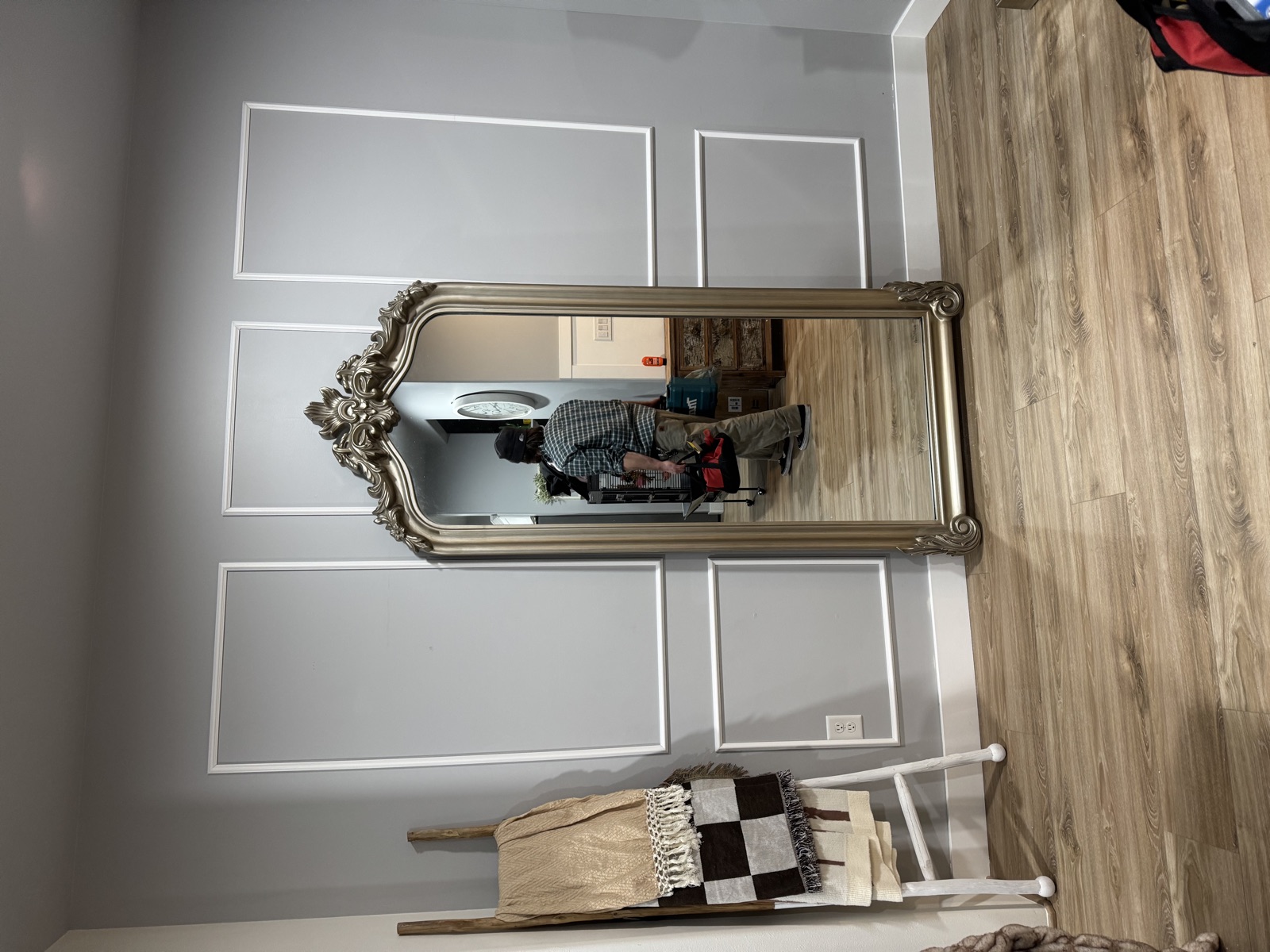
You can paint a room three coats of the prettiest color on the wall, and if the baseboards are dinged up, the casing is gappy at the corners, and there's a hairline shadow where the crown meets the ceiling — the room won't feel done. Your eye will know.
That's why finish carpentry is the quiet difference between a renovation that reads "homeowner" and one that reads "professional." Same paint. Same furniture. Different trim. Different room.
This is the work I genuinely love most, and the work that takes the longest to do correctly. Here's what I install, where I see homeowners get tripped up, and why the last 10% of the job is 90% of the difference.
Baseboards: The Easiest Upgrade You Keep Putting Off
Baseboard is the single highest-impact trim upgrade in most NoVA homes, because most builder-grade baseboards are a sad 3.25" of clamshell that disappears against the wall.
A real baseboard upgrade — taller (5.25" or 7"), cleaner profile, properly caulked and painted — adds visible weight to every room you walk into. It's the trick interior designers use to make new construction feel like it was built thirty years ago, in a good way.
The steps that actually matter:
- Pull the old base off carefully. The drywall behind it is usually paint-bare and ragged. Patch and sand before the new base goes on.
- Scribe to the floor. Wood floors are never perfectly flat. A board run straight will gap in some spots. A scribed board sits tight.
- Cope, don't miter, the inside corners. This is the thing that separates handyman work from finish carpentry. Mitered inside corners look fine on day one and open up to a black line by next winter as the wood moves. A coped joint stays tight through humidity changes. (More on this below.)
- Set the nails. Then fill the holes with painter's putty, not wood filler. Painter's putty stays flexible. Wood filler cracks.
- Caulk top and bottom. Top to the wall, bottom to the floor if the gap calls for it. Smooth bead, immediate wipe with a damp finger.
- Two coats of paint. One coat is never enough on raw primed trim, no matter what the can says.
A single normal-sized bedroom of baseboard is a Full-day handyman block when you do it right — measure, cope, install, fill, caulk, two coats, walk-through. People who try to "knock it out in a half-day" usually skip steps 3 and 6, and you can see it in the corners and in the sheen.
Coping vs. Mitering: The 90-Second Explanation
This is the single piece of carpentry vocabulary worth knowing as a homeowner.
When two pieces of baseboard or crown meet in an inside corner (the corner that points away from you), they can be joined two ways:
- Mitered. Both boards cut at 45 degrees, meeting at a point. Fast, easy, and what most homeowners (and a lot of handymen) do.
- Coped. One board is butted square into the corner. The second board is cut to the profile of the first using a coping saw, so it nests against the first piece. Slow, fussy, and what finish carpenters do.
A mitered inside corner looks identical to a coped one on installation day. The difference shows up in month two. Wood expands and contracts with humidity. A mitered joint opens up — a thin black line appears where the two pieces meet — and never closes back up. A coped joint can move and stays tight, because the back-cut allows for the movement.
Outside corners (corners that point toward you) are mitered. Outside corners aren't the problem. Inside corners are.
If you ask one question about your trim contractor, ask if they cope inside corners. The answer tells you what kind of work you're getting.
Crown Molding: Worth It, Bigger Project Than People Expect
Crown is the single biggest visual upgrade in a room — and the single most underestimated job in finish carpentry.
A typical homeowner sees "install crown in the living room" and pictures four sticks of molding and a nail gun. The reality:
- Crown is cut on the flat at compound angles. Not every saw can do it cleanly. Mine can.
- Every corner has to be coped (inside) or mitered (outside) and every joint has to be backed up with blocking or it'll move.
- Walls are never exactly 90 degrees. Each corner gets test-fit and adjusted before it goes up.
- Top and bottom caulk lines, holes filled, two coats. Same as baseboard, more time per linear foot.
A single average-sized living room of crown is a full-day, possibly a day-and-a-half with the painting. Two rooms is a multi-day job, not a multi-hour one. That's the honest framing.
Casing: The Trim Around Doors and Windows
Door and window casing is the trim people stop noticing once it's been installed for a year. Until you upgrade it, and then you can't stop noticing.
The two upgrades worth doing:
- Wider casing. Builder casing is usually 2.25" or 2.5". Going to a 3.5" or wider casing makes every door and window in the room feel more important.
- A header / rosette / craftsman-style top. A flat board across the top of a doorway, optionally with a small cap, gives the casing weight without going formal. Especially good in 1980s and 90s NoVA colonials that want a craftsman touch.
Casing an entire room of doors and windows fits a full-day. A single front door upgrade with new casing and a new handle set is the high-impact half-day version (and pairs naturally with the door upgrade post).
Wainscoting and Picture Frame Walls
Wainscoting is having a moment in Northern Virginia and it deserves the attention. Real wainscoting — recessed panel, board-and-batten, or shaker-style — turns an ordinary dining room into a room you photograph.
The two flavors I install most:
- Board-and-batten. Vertical battens on a smooth panel, with a chair rail cap. Clean, modern, fits any house from a 1970s rambler to a new-construction colonial.
- Picture frame wainscoting. Boxes built out of casing or panel molding applied directly to the wall below a chair rail. Looks expensive, painted-and-caulked correctly, and a great option for a powder room or dining room.
Wainscoting is layout work first, carpentry second. Get the math right at the start — batten spacing, rail height, what happens at outlets and switches — and the install is straightforward. Get the layout wrong and you'll see it forever.
A full wall of wainscoting is a full-day. A whole room is usually two days. This is the same kind of detail work that makes a Refresh project feel finished — the carpentry and the caulk are why a tile-and-vanity job stops looking like a renovation and starts looking like a remodel.
Why "Two Coats and a Clean Caulk Line" Is the Whole Game
The dirty secret of finish carpentry is that the wood is the easy part. The finish is everything.
I can install a piece of base in 20 minutes. The filling, sanding, caulking, and two coats of paint after that is another 45. That's a 3:1 ratio of finish work to carpentry work, and that's where homeowner installs (and rushed handyman installs) fall apart.
The four things that separate clean trim from rough trim:
- No nail holes visible. Set, fill, sand, prime spot, paint.
- No gaps at the wall. A bead of paintable caulk, smoothed immediately, paint over it.
- Tight corners. Coped inside, sharp outside.
- Two coats of paint, brush marks invisible. Roller on the flat sections, brush on the profile, light sand between coats.
That's the part where I take longer than the "$300 for the day" handyman and faster than the trim contractor who'll be back next week. It's also the part you'll see for the next twenty years.
Cheat Sheet: What Fits a Day Block
| Project | Block |
|---|---|
| Touch-up: caulk + repaint existing trim, one room | Half-day |
| Baseboard, one average bedroom (install + finish) | Full-day |
| Baseboard, full main floor | Multi-day project |
| Crown, single living room | Full-day |
| Crown, two rooms | Multi-day project |
| Door + window casing upgrade, one room | Full-day |
| Single front-door casing upgrade | Half-day |
| Wainscoting, single accent wall | Full-day |
| Wainscoting, full dining room or powder room | Multi-day project |
| Picture rail or chair rail, single room | Half-day |
Anything labeled "multi-day project" is the territory where day-blocks stop making sense and the work becomes a quoted project. That's a normal handoff — at some point the list is too long to fit in a single day no matter how efficiently you run it.
When to Call
Three signs your house is ready for a trim upgrade:
- You painted recently and the new wall color makes the old baseboards look beat up.
- You added higher ceilings or new lighting and the room still feels short — that's a crown molding cue.
- You upgraded a single room (refinished floors, new paint, new fixtures) and it still doesn't quite land. That's almost always a finish-carpentry gap.
Got a room (or three) that needs trim, baseboards, or wainscoting to make it feel finished? Send the details through a Handyman Day Request and we'll scope the day — or the project — honestly.
Picture your finished room
Walk through your room, your style, and what stays or goes. We come back with a personalized plan and quote within 24 hours — no pressure, no obligation.
Start the Refresh DesignerReady to Get Started?
Get a free, no-obligation quote for your project. We typically respond within the hour.