Mounting a TV, Gallery Wall, or Floating Shelf — Done Right the First Time
By Brandon Mayernik · June 12, 2026
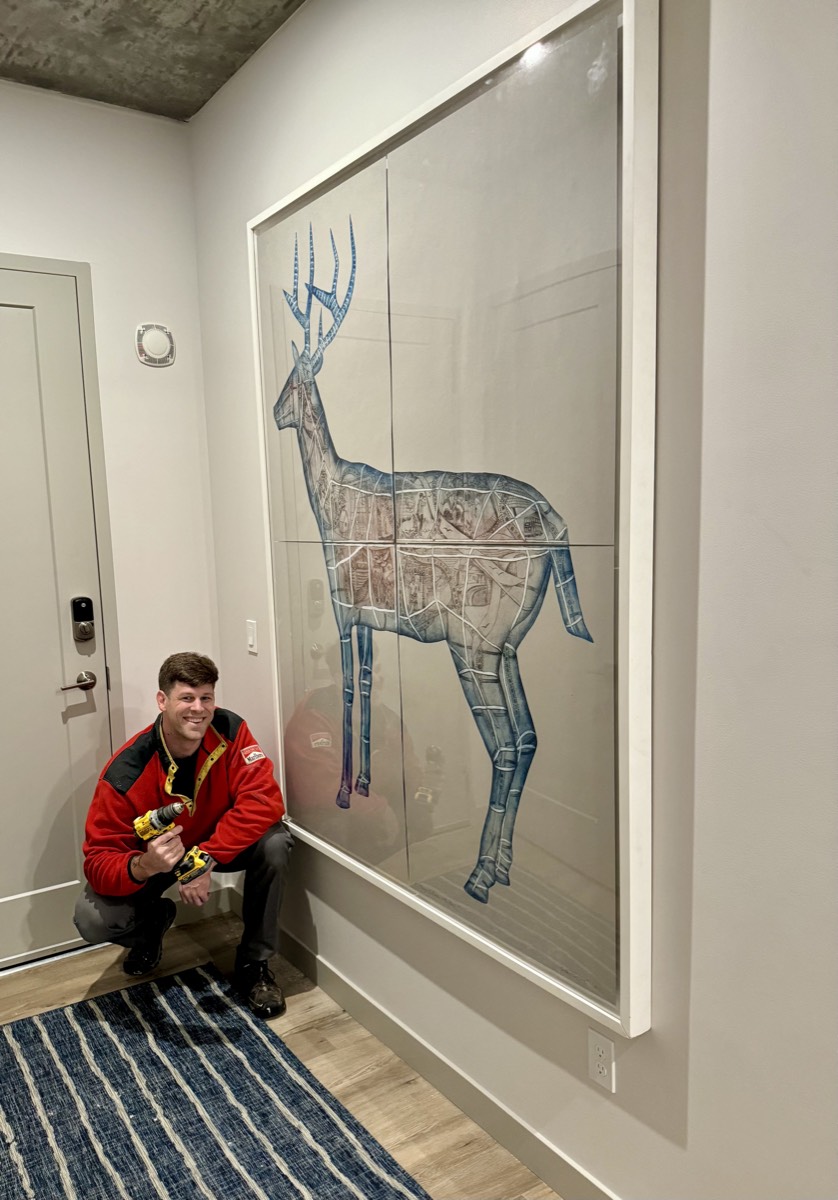
Half the mounting calls we take start with a version of the same sentence: "I tried to do it myself and now there's a hole."
The other half start with: "I bought the TV mount six months ago. It's still in the box."
Both are reasonable places to be. Mounting things on walls is one of those jobs where the cost of doing it wrong is higher than the cost of doing it right — a fallen TV, a floating shelf full of books torn out of drywall, a gallery wall that's almost level but reads off from the doorway. The whole point of paying someone is so you don't have to live with that for the next five years.
VHS sits between the handyman who throws an anchor in the wall and hopes, and the AV contractor who charges $1,200 for a single TV. If you've got a wall and a thing that needs to go on it, here's how we think about scoping it.
The Real Variable: What's Behind the Wall
Almost every mounting decision comes down to what's behind the drywall. Three categories:
Studs. The gold standard for anything heavy — TVs, mirrors over 30 lbs, floating shelves carrying real weight. Stud-mounted, with proper lag bolts, holds essentially forever.
Drywall only. Lighter art, smaller mirrors, towel bars. Needs the right anchor — toggle-style for heavier items, plastic for light. Not "ribbed plastic anchor straight from the package the screw came in" — those fail under load over time.
Plaster, masonry, or brick. Common in older Vienna, McLean, and Mount Vernon homes, and on any fireplace surround. Plaster needs toggles into the lath cavity. Brick or stone needs masonry anchors and a hammer drill. A standard drywall anchor in plaster will pull out within a year.
The reason we walk a wall with a stud finder and a small pilot before committing is because what the stud finder shows isn't always what's there. Old homes have ghost framing, blocking, plumbing chases, and surprise HVAC. Two minutes of checking saves a wall repair later.
TV Mounts
The cleanest TV install is studs + in-wall cable conceal + a tilting or full-motion mount sized for the TV. The order that matters:
- Find the studs and confirm with a pilot.
- Mount the bracket level (not eyeball-level — laser-level).
- Run a power relocation kit so the outlet is behind the TV, not under it. (This is what makes the "no wires showing" look possible without an electrician.)
- Drop the HDMI / power conduit inside the wall.
- Hang the TV, manage the cable run inside the cabinet below.
Above the fireplace. This is the most-requested mounting job we get, and it has the most landmines. Two rules:
- Heat clearance. If your fireplace mantel doesn't push the heat out far enough, the TV cooks. We measure the top-of-firebox-to-mantel distance and the mantel depth before agreeing to mount. If it's marginal, we say so.
- What's behind the surround. Brick, stone, or a wood chase? Each changes the bracket, the bit, and the anchors.
In-wall conceal vs. cable raceway. In-wall conceal is the clean look — wires drop down inside the drywall to an outlet below. It's only possible if the wall cavity is open (no fire blocking, no insulation in the way for an exterior wall). Otherwise we use a paintable raceway that disappears against the wall color.
A single TV mount with a clean cable conceal is usually a half-day block. Two TVs in different rooms, or a TV-over-fireplace with surround complications, leans full-day.
Gallery Walls and Art
The mistakes on gallery walls are usually one of three:
- Off-center to the wall. Visually, the gallery needs to center on the wall or on the furniture below it — not split the difference.
- Inconsistent spacing. Eye notices 2" vs. 2.5" gaps immediately.
- Hung too high. The center of the arrangement should sit at roughly 57"–60" from the floor. Above eye level it reads disconnected from the room.
Our process is a paper template on the floor, then a paper template on the wall, then commitment. Painters tape and a laser level, marks all transferred, then everything goes up in one pass. The kind of thing that looks chaotic from a distance and obviously planned up close.
Anchors matter. Most gallery art ends up partly on studs and partly on drywall. Mixed anchoring is fine — what matters is that the right anchor is matched to the right piece's weight.
A typical 3–7 piece gallery wall fits inside a half-day, often paired with a TV mount or a fixture swap.
Floating Shelves
The "floating shelf falling off the wall" problem is almost always one of two things:
- The shelf bracket wasn't mounted into a stud and the shelf is carrying real weight.
- The shelf bracket was mounted into a stud, but only one side of the bracket was — and the off-stud side eventually pulled loose under load.
Floating shelves that are decorative (one candle, one frame) can live on toggle anchors. Floating shelves that carry books, plants, or a speaker need to land on studs across the full run. If the stud spacing doesn't match the shelf length, we either re-size the shelf, add backing, or pick a different style.
A short floating shelf install is part of a half-day. A floor-to-ceiling shelf run on one wall — measure, level, anchor every shelf to studs — is usually a full-day.
Mirrors, Mounts, and Heavy Things
Mirrors over 30 lbs need stud-mounting or a French cleat. The French cleat is our default for anything heavy where we can hide the cleat behind the piece — it spreads the load across multiple studs and lets the piece sit dead flat against the wall. The cleat goes up, the matching cleat goes on the back of the mirror, and the piece drops down onto it.
Bathroom mirrors, mounted artwork, and antique pieces all benefit from a cleat. It also makes the piece easy to take down later for painting.
Scope Cheat Sheet
| Project | Block |
|---|---|
| Single TV mount + cable conceal | Half-day |
| TV over fireplace (brick, masonry anchors) | Half-day |
| 3–5 piece gallery wall + a few pictures | Half-day |
| 1–2 floating shelves on studs | Half-day |
| Large mirror on French cleat | Half-day |
| TVs in 2+ rooms + gallery wall | Full-day |
| Full wall of floating shelves | Full-day |
| Whole-house art install (move-in) | Full-day |
When You're Ready
If you've got a TV waiting in a box, a stack of art leaning against a wall, or a shelf bracket you bought eighteen months ago and never installed — send the list. Photos of the wall help. So does telling us what's behind it if you know.
Send the list via the Handyman Day Request form and we'll tell you what block it fits, what anchors we'll use, and what to expect.
Picture your finished room
Walk through your room, your style, and what stays or goes. We come back with a personalized plan and quote within 24 hours — no pressure, no obligation.
Start the Refresh DesignerReady to Get Started?
Get a free, no-obligation quote for your project. We typically respond within the hour.